Rensselaer is one of the few universities to offer an undergraduate program in this emerging field.
Computational biology is the study of biological systems through computational and statistical modeling of large data sets. Through this program, students gain knowledge in biology, computer science, and information technology.
Rensselaer is one of the few universities to offer an undergraduate program in this emerging and exciting field. This program trains next-generation biologists who can harness the ever-rising computational power and tools to solve crucial biological problems to change the world.
There are two concentrations within the program: biomolecular systems and ecological systems. The biomolecular systems concentration focusing on applying computational methods on a microscopic scale to the structure, dynamics and interactions of protein, nucleic acid, glycan, biomembrane and drug discovery. The ecological systems concentration focuses on applying computational methods to study and solve problems in large scale ecological systems, such as regional to global environmental changes.
Graduates are encouraged to continue their studies in one of the growing number of worldwide computational biology graduate programs. Those who enter the workforce following graduation often are hired into sectors including the pharmaceutical industry, medical informatics, agricultural bioinformatics, government agencies and national labs, database management companies, or the biotechnology industry.
Program of Study
In this major, you can choose a concentration in biomolecular systems or in ecological systems.
As a result of completing this program students will:
- Scientific Process: Be able to properly describe and apply the process of science, use the scientific method to answer biological questions including the ability to find and comprehend scientific literature, develop testable hypotheses, design and conduct experiments, and collect, analyze, and present scientific data.
- Quantitative Reasoning: Be able to process, analyze, and visualize data to draw correct conclusions while using appropriate statistical methods.
- Models and Simulations: Be able to understand and apply scientific models or simulations including both statistical models and system-level models or simulations.
- Interdisciplinary: Be able to apply knowledge and skills from across the curriculum to current problems in biological sciences to generate integrative papers, proposals, or other types of projects.
- Communication and Collaboration: Be able to communicate effectively on scientific topics in written and oral formats. Be able to collaborate with peers and work together to achieve a common goal.
- Science and Society: Be able to recognize and discuss ethical issues in biology and develop an understanding of how science impacts our society.
The B.S. in Computational Biology (128-Credits) offers a wide variety of coursework in Biological Sciences and two concentrations for you to customize your degree path.
2026-2027 Academic Year Computational Biology, B.S. Curriculum
In this program, you’ll learn to think like a researcher and gain the essential skillset to carry out research in computational biology. All students are required to complete a culminating experience advanced laboratory course, which offers preparation for research in your career. Select students may perform independent research in faculty labs, through an internship or co-op.
The Biological Sciences faculty provide a variety of research opportunities for undergraduate and graduate students enrolled in our degree programs. Students who are interested in pursuing research themselves or learning more about what faculty members in our department should consult the Biological Sciences Research page.
Academic Opportunities
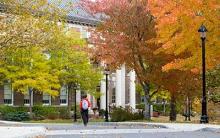
Student researchers play a critical role in the world-changing discovery, innovation, and breakthroughs taking place across campus.
Tri-Beta Biological Honor Society is for undergraduate students dedicated to improving the understanding and appreciation of biological study, and extending the boundaries of human knowledge through scientific research.
Alpha Epsilon Delta is the National Health Preprofessional Honor Society dedicated to the encouragement and recognition of excellence in preprofessional health scholarship.
